4.1 Properties of materials
4.1 Properties of materials
Physical properties:Mass
- amount of matter that a body contains.
Weight
- the measurement of the gravitational force acting on an object, mass of 1kg = 9.8 N on earth
- the quantity of a 3-dimensional space enclosed by some closed boundary
- is the mass per unit volume of a material, it's importance is in portability of a product's weight and size. (instant noodle)
- a measure of a material's ability to conduct electricity. Low resistivity = conduct electricity well.
- a measure of how fast heat is conducted through a slab of material with a given temp. difference across the slab. Important for objects that will be heated or must conduct/insulate heat.
- a measure of the degree of increase in dimensions when an object is heated.
- resistance a material offers to penetration or scratching. Ceramic floor tiles are extremely hard and resistant to scratching or cutting devices.
Mechanical properties:
Tensile strength
- ability of a material to withstand pulling forces (ropes, cables)
- ability of a material to withstand being pushed or squashed (bricks, steel, concrete)
- the ability to absorb energy without fracturing (hit by a baseball bat without breaking)
- the resistance of an elastic body to a deflection by an applied force. It is important consideration for an airplane wing, where maintaining shape is crucial to performance.
- the ability of a material to absorb energy and plastically deform without fracturing.
- the ability of a material to be changed in shape permanently by external blows or pressure, without cracking or breaking.
- a measure of the stiffness of an elastic material and is a quantity used to characterise materials. It is defined as the ratio of the stress (force per unit area) along an axis to the strain (ratio of deformation over initial length) along that axis in the range of stress.
Plastic range- If a material is stressed to the elastic limit, it will move into the plastic range where the material will permanently deform (stretch to show ductility)

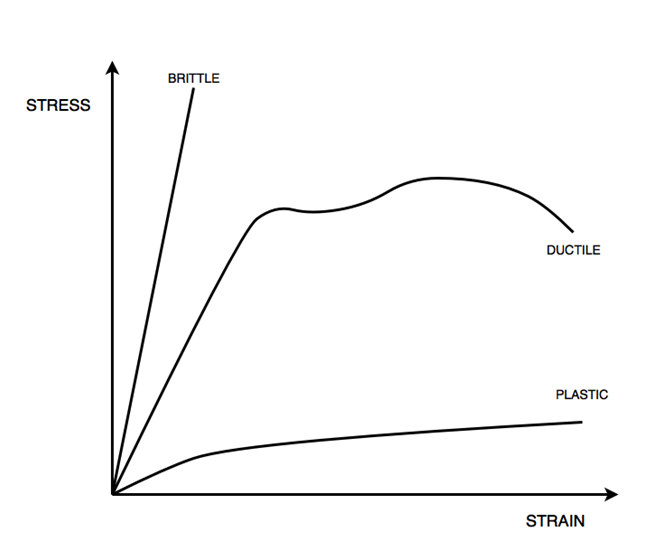
Stress
- the force per unit area of a material and is normally determined by applying a tensile force to a sample of material.
- extension per unit length. Some extension of elongation is expected after tensile force is applied.
Properties of smart material
Photochromicity

- a material that can described as having a reversible change of colour when exposed to light.
- Example such as colour-changing sunglasses lenses, which can darken as the sun brightens.
- A chemical on the surface of the lens reacts to UV light.
Thermoelectricity
- generated by a device that converts heat and the temperature difference between two materials directly into electrical energy.
- This electricity can be used to measure, monitor and control temperature.

Magneto-rheostatic, electro-rheostatic
- These materials are fluid that can undergo dramatic changes in their viscosity.
- They can change from a thick fluid to a solid in a fraction of a second when exposed to a magnetic (for MR materials) or electric (for ER materials) field, and the effect is reversed when the field is removed.

Comments
Post a Comment